

Webflow EU Hosting: Does It Change Anything for Your Website?
- If your Webflow site is set up properly, you don’t have to change anything.
- Webflow EU Hosting launched on November 17, 2026. Site data is stored in Ireland, with failover in Germany.
- It’s only available on specific Enterprise plans, through Webflow’s sales team.
- It’s a separate Webflow environment with its own login. Apps, Analyze, Optimize, Campaigns and AEO aren’t available there yet.
- Some data can still leave the EU: CDN caching, some subprocessors and support access.
- EU hosting isn’t the same as GDPR compliance. That depends on your forms, cookies and scripts, on any plan.
Short answer: probably not. Since 2023, we’ve built Webflow sites for 75+ brands, most of them in Belgium and across Europe. That includes Belgian companies like Lanark and ImmuneWatch. Every one of them runs on standard Webflow hosting, because EU Hosting didn’t exist until November 17, 2026. None of them have to move now.
EU hosting has been on the Webflow wishlist for years, so it’s good news. It just changes less than the headlines might suggest.

What Is Webflow EU Hosting?
It’s a separate copy of Webflow that runs in Europe. Your CMS content, assets, form submissions, backups, localized content and ecommerce data are stored in the EU, on AWS in Ireland. Germany is the backup region if Ireland goes down.
It isn’t a setting you switch on for an existing site. EU sites live in their own environment, with their own databases, backups and login at eu.webflow.com. Webflow has to set up your Workspace for it first.
You also don’t need to be based in Europe to use it. It’s available to any company on an eligible Enterprise plan.
What’s Different Now?
Here’s the side-by-side (based on Webflow’s docs):
What EU Hosting Doesn’t Change
The data at rest moves to Europe. A few things around it don’t.
- CDN caching: copies of your published pages are still cached around the world, so your site loads fast everywhere.
- Subprocessors: some third parties that power specific features or support can still process data outside the EU.
- Access: Webflow says EU Hosting controls where data is stored, not who can access it. Authorized staff outside the EU can still access it for support, maintenance or security.
- Ownership: Webflow is still a US company. Under the US CLOUD Act, US authorities can ask US providers for data they control, even when it’s stored abroad. EU-hosted doesn’t mean EU-owned.
None of this makes EU Hosting pointless. It just means “our data is in the EU” is a more accurate sentence than “our data never leaves the EU”. If your legal team needs the second one, read the subprocessor list before you sign.
Was Your Webflow Site Already Fine Under GDPR?
Yes, if it was set up properly. GDPR doesn’t require data to stay in the EU. It requires a legal basis for moving it out, and Webflow already had that.
Webflow is certified under the EU-U.S. Data Privacy Framework, and its Data Processing Addendum includes the EU Standard Contractual Clauses. That’s what most European companies on Webflow have relied on until now, and it’s still valid on standard hosting.
So why does EU hosting matter at all? Because the deal that lets EU data go to the US isn’t guaranteed to last. It’s being challenged in the EU’s top court, and that court has already scrapped the last two deals like it, in 2015 and 2020. For some legal teams, EU hosting is a backup plan in case it happens again.
And remember: Webflow is the processor, you’re the controller. Your forms, cookies and tracking scripts are still your job, wherever the site is hosted.
Where Personal Data Lives on Your Website
On most B2B websites, the pages aren’t the problem. Your product pages, blog and case studies are public anyway. The personal data comes in through a few specific places:
- Forms: demo requests, contact forms and newsletter sign-ups.
- File uploads: CVs, contracts or IDs sent through forms. Often the most sensitive data on the whole site.
- Analytics and tracking: cookies, pixels and session recordings.
- Third-party scripts: chat widgets, scheduling tools and embedded videos.
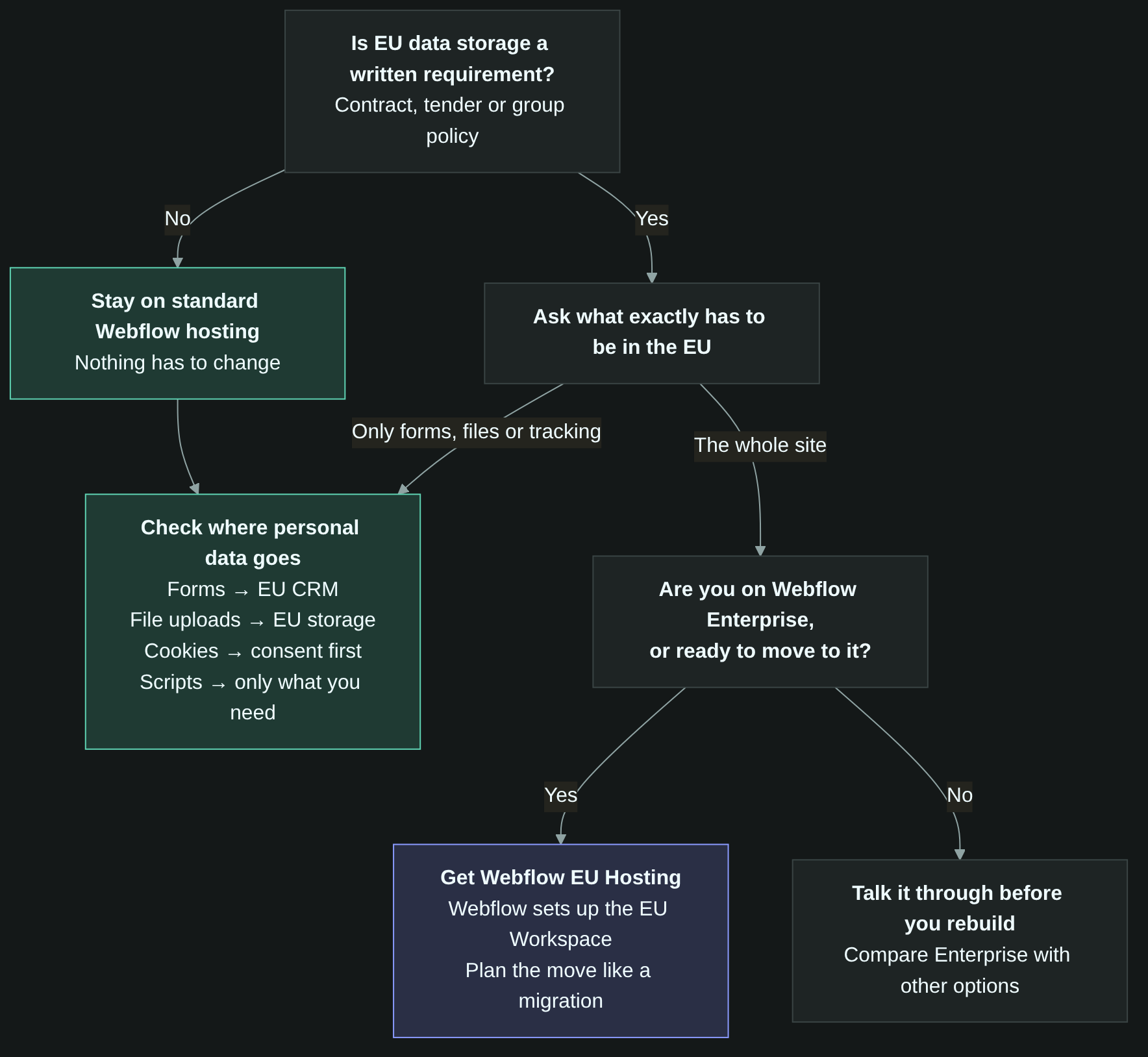
That’s why I always start with one question when a client asks about EU hosting: what exactly has to be in the EU? Most of the time, it’s the form data and the tracking, and you can sort that out on any Webflow plan.
Check HeronTrack. Their site runs in Dutch, French and English, so it collects leads from several European markets. The work there isn’t the server location. It’s making sure every form, language and script is set up the same way.
Same with Lanark, a Belgian supply chain consultancy. When we built their site, the privacy-relevant work was routing every form to the right person, with confirmations in place, and setting up tracking across the key journeys. That’s where a website’s personal data actually goes, and it’s what any review should look at first.
How to Keep a Webflow Site EU-Friendly Without Enterprise
This is the setup I’d recommend for a European company on a standard Webflow plan:
- Sign Webflow’s DPA. It covers your relationship with Webflow as a processor, including the Standard Contractual Clauses.
- Send forms to an EU-hosted tool. For example, use HubSpot forms with HubSpot’s EU data center, so submissions go straight to your CRM in Europe. More in our Webflow and HubSpot integration guide.
- Store uploaded files in the EU. Use a form or file tool that stores uploads in Europe, instead of collecting CVs or contracts through native Webflow forms.
- Block tracking until people consent. Use a consent tool that stops analytics and marketing scripts from loading until the visitor says yes.
- Consider EU-based analytics. Tools like Plausible or Matomo keep visitor data in Europe, if your policy requires it.
- Write it down. A one-page data map (what you collect, where it goes, which agreement covers it) answers most procurement questions before they’re asked.
My suggestion: Do this before you ask Webflow for an Enterprise quote. If your legal team is happy with this setup, you’ve saved yourself an Enterprise contract. If they still require full EU residency, you’ll go into that conversation knowing exactly why.
Who Should Move to EU Hosting?
EU Hosting makes the most sense when EU residency is a written requirement, not a preference:
- Public sector and education: tenders and contracts that require EU data storage.
- Regulated industries: finance, healthcare and legal teams with strict group data policies.
- Large companies with procurement checklists: where “hosted in the US” blocks the project, no matter what the DPA says.
- Teams already on Enterprise: if you’re paying for Enterprise anyway, asking about EU Hosting is an easy win.
Being in a regulated industry doesn’t automatically mean you need it. For example, ImmuneWatch is a Belgian healthcare company that analyzes T-cell data with machine learning.
Their website explains that technology to researchers, partners and investors, but the data analysis itself doesn’t run on the website. So the site is a marketing site like any other, and it runs on standard Webflow hosting.
If you run a B2B SaaS or tech marketing site, I wouldn’t lose sleep over this. Get your forms, cookies and scripts right with the setup above, and you’re covered.
How Do You Get Webflow EU Hosting?
Through Webflow’s sales team, on an eligible Enterprise plan. You can’t switch it on yourself, and an existing site doesn’t move with a click. Here’s what the process is:
- Confirm the requirement. Get it in writing: what has to be stored in the EU and why. That decides whether you need EU Hosting at all.
- Map your data. List your forms, uploads, scripts and integrations, and where each one sends data.
- Talk to Webflow. Webflow’s account team confirms your eligibility and the Enterprise plan, and sets up your EU Workspace.
- Build or move the site. EU Hosting is a separate environment, so an existing site moves like a migration. Check which Marketplace apps you rely on, since they aren’t available there yet.
- Test and switch. Test every form and integration, check URLs, redirects and the sitemap, then switch the domain.
Webflow handles the contract and the EU Workspace. Steps 1, 2, 4 and 5 are where most of the work is, and that’s what we do with our clients.
Is Anything Different Now?
For most European companies, no. If your Webflow site handles forms, cookies and scripts properly, it was fine before November 17, and it’s fine now. You don’t need to move.
If EU storage is a written requirement, something did change: Webflow is now an option where it wasn’t before. That’s real news for public sector, regulated and large European companies that loved Webflow but couldn’t sign off on US hosting.
Either way, start with the data map, not the hosting contract. And if you want a second opinion on your current setup, or help moving to Webflow EU Hosting, talk to us.
Frequently Asked Questions
Yes. Webflow launched EU Hosting on November 17, 2026. Site data is stored at rest in the EU, on AWS in Ireland, with failover in Germany. It’s available on specific Enterprise plans through Webflow’s sales team.
No. EU Hosting is only available on specific Enterprise plans for now. Sites on Basic, Premium and other site plans stay on Webflow’s standard US hosting.
Yes, Webflow can be used in a GDPR-compliant way on any plan. It’s certified under the EU-U.S. Data Privacy Framework and its DPA includes the EU Standard Contractual Clauses. But compliance also depends on how you handle forms, cookies and tracking on your own site.
Not all of it. Site data is stored at rest in the EU, but CDN caching, some subprocessors and support access can involve locations outside the EU. Webflow is also a US company, so US laws like the CLOUD Act still apply.
Possibly. Existing Enterprise customers may be eligible, and Webflow’s account team handles each migration case by case. Since EU Hosting is a separate environment, test forms, integrations and redirects before switching your domain.